


Sample quilt in Calico Days by Lori Holt for Riley Blake Designs.
Sample quilt in Strawberry Biscuit by Elea Lutz for Penny Rose Fabrics.
Sample Quilt in Spooky Delight by Bunny Hill Designs for Moda Fabrics.
Sample Quilt in Midnight Clear by 3 Sisters for Moda Fabrics.
Finished size: 18 ½” x 18 ½”
Sample quilt in Strawberry Biscuit by Elea Lutz for Penny Rose Fabrics.
Sample Quilt in Spooky Delight by Bunny Hill Designs for Moda Fabrics.
Sample Quilt in Midnight Clear by 3 Sisters for Moda Fabrics.
Finished size: 18 ½” x 18 ½”
Step 1: Collect all the goodies:
- (36) 2 ½” squares
- 1/4 yard sashing fabric, sub cut as follows:
- Cut 2 strips 1 ½” x WOF.
- Sub cut into (6) 1 ½” x 4 ½” strips and (2) 1 ½” x 14 ½” strips.
- Cut 2 strips 2 ½” x WOF.
- Sub cut into (2) 2 ½” x 14 ½” strips and (2) 2 ½” x 18 ½” strips.
- Cut 2 strips 1 ½” x WOF.
- 1/6 yard binding fabric, sub cut as follows:
- Cut 2 strips 2 ¼” wide and piece together for binding.
- 26 ½” x 26 ½” backing piece (or as required per your quilter)
- 2 yards of decorative trim (crocheted trim, lace, ribbon)
- buttons
Note: WOF (Width of Fabric); RST (Right Sides Together)
Step 2: Create the Four-Patch Squares
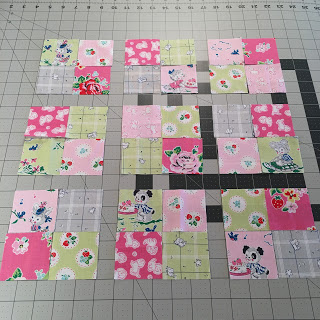
Lay out the (36) 2 ½” squares into (9) four-patch squares so that you have a nice mix of color and patterns.

Sew each group into a four patch. First sew the top two squares together and press to one direction. Then sew the bottom two squares together and press to the other direction.


Nest the seams and sew these two units together. Press this horizontal seam open. Repeat to create 9 four patches. Each four patch should measure 4 1/2\” x 4 1/2\”.


Step 3: Add the sashing
Lay out the four patches and vertical sashing. Sew each row together working from left to right. Press seams toward the sashing.


Lay out the completed rows and the horizontal sashing. Sew these units together, moving from top to bottom. Press seams toward the sashing. Note: When I placed one row RST on top of another row, I pulled the top unit back a bit to take a look and make sure the vertical sashings were lined up. (see image below)


Step 4: Add the borders
Sew the 2 1/2\” x 14 1/2\” border to the top and bottom of the quilt. Press to the border.
Sew the 2 1/2\” x 18 1/2\” border to the left and right of the quilt. Press to the border.


Step 5: Quilt as desired
Layer your quilt top, batting, and backing using your preferred method of pinning, thread or spray basting. Since this is such a small piece, I found that fabric adhesive was enough to keep my quilt in place and flat during quilting. I kept my quilting simple, using a pleasing grid design and allowing the fabric to be the star of the show. When you have finished the quilting, trim the backing and batting.


Step 6: Binding
The next step is to bind your quilt as desired. I used 2 ¼” strips for my binding. My preferred method is to machine bind to the top, and hand stitch the binding to the back to finish.

Step 7: Embellish with trim and buttons
NOTE: Typically the final step is to bind the quilt, but I chose to add the embellishments after binding since I was using a more delicate, vintage trim.
The methods for attaching any kind of trim (crochet work, lace, ribbon) may need to vary depending on the design and condition of the trim. If it is very delicate or intricate, you may need to attach by hand.
I used a spray adhesive on the back of my trim pieces to temporarily adhere them to the top of the quilt. I use 505 Spray Adhesive, which is acid free and temporary. This adhesive is sticky enough to hold the trim in place, but it also allows you to pick up a piece to reposition it.


When I got to the corners, I simply turned the trim as best I could and did a bit of tucking. My pink and white trim came in two pieces, so unfortunately I had to match two seams. I put the seams on the corners as I knew I would also be attaching vintage buttons.


After I had the trim lying flat and looking nice, I sewed it in place using matching thread and my walking foot. I sewed very slowly to ensure that the trim did not get caught and bunch up.


Finally, I hand stitched the corners just a bit to keep the trim in place and then added the buttons.


Please share your finished project on Instagram using this hashtag: #coffeetimequilt